



Reports
Each year United Power makes available an annual report of our operations to all of the cooperative members. Download past annual reports here, or email us your name and mailing address and we’ll gladly mail you a copy.
2025 Annual Report
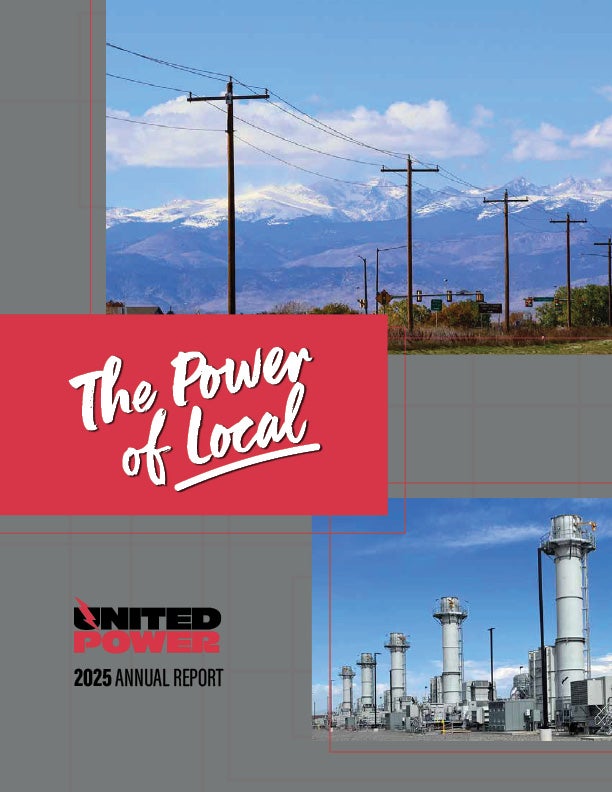
2024 Annual Report
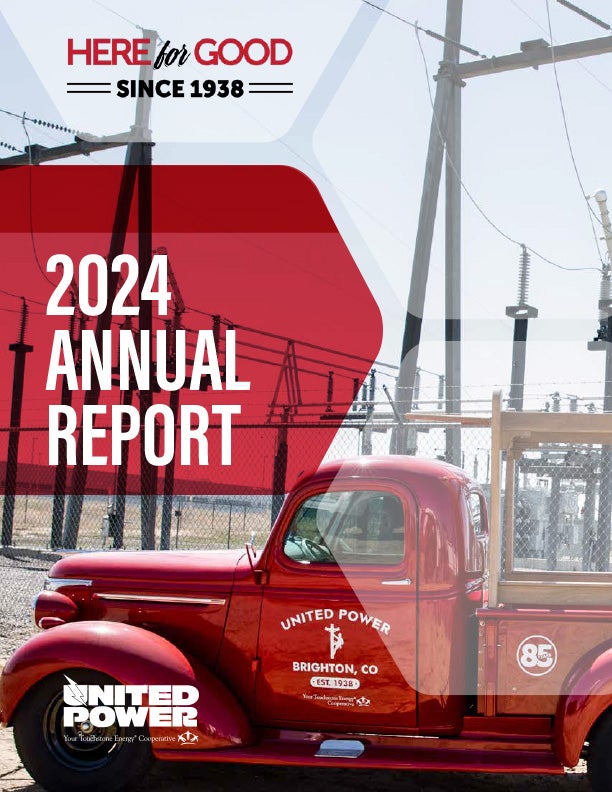
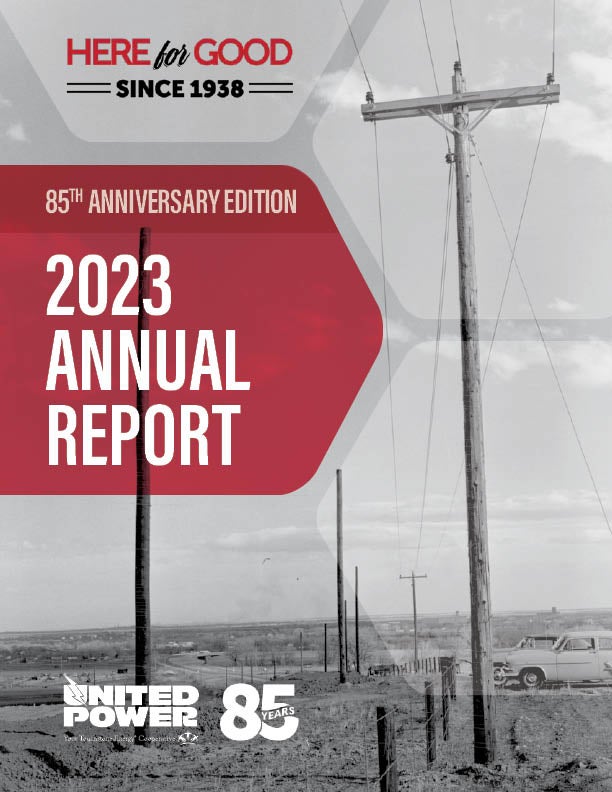
2023 Annual Report
United Power completed its first Integrated Resource Plan (IRP) in 2026. The plan establishes how the cooperative will prepare for energy needs 20 years into the future accounting for factors such as load growth, technology costs, and environmental considerations while continuing to deliver reliable, affordable power to its members. It evaluates the resources required to serve United Power’s growing electricity demand, the costs associated with developing and purchasing power, and the challenges that may affect members in the years ahead.
As United Power moves forward following the conclusion of its single wholesale power contract in May 2024, comprehensive energy and demand planning has become increasingly important. The IRP provides the cooperative with a clear framework to meet policy requirements such as Colorado emission goals set for utilities, anticipate future cost pressures, and identify strategic partners that can help maintain reliable service and stable costs for members.
The IRP is centered on three priorities that are most important to members: reliability, cost stability, and reduced emissions from the power the cooperative delivers to its members.
Reliability
Reliable power is the foundation of the plan. The IRP enables United Power to plan for a power supply portfolio that can keep pace with members’ evolving needs. This includes serving new homes and businesses, while also preparing for the increased use of electric technologies in daily life. Many households are adopting electric vehicles, heat pumps, and other electric technologies, and businesses are pursuing greater electrification as part of broader efforts to reduce carbon emissions.
Planning for reliability also requires a clear understanding of when and how members use electricity. United Power must be prepared for the busiest and hottest days of the year, when demand is highest. The IRP also accounts for resources already connected to the system, including rooftop solar, generators used during peak periods, and batteries that store energy for later use. These resources can provide meaningful value, particularly when power supplies are constrained, but they must be planned for and coordinated carefully. Furthermore, United Power joined Southwest Power Pool’s Regional Transmission Organization Expansion, or SPP RTOE, on April 1, 2026. All utilities in the state of Colorado are focused on meeting current and future resource adequacy requirements to maintain reliability across the larger bulk power system, ultimately bolstering resiliency to the cooperative’s system.
The plan helps United Power anticipate circumstances that could affect the cost or reliability of power and make informed decisions to address those challenges on behalf of members.
Cost Stability
The cost of producing and delivering power continues to rise, making cost management a key factor in United Power’s planning. Wholesale power remains the largest component of member rates, while other costs are becoming increasingly significant. One example is transmission—the cost of moving power from where it is produced to where it is used. Similar to a heavily used toll road with rising fees, transmission can become more expensive when many utilities rely on the system at the same time. To help manage these costs, United Power is adding more local resources, including local natural gas plants and solar facilities within its service territory. This approach helps the cooperative serve member needs while reducing reliance on more expensive alternatives.
Stable and predictable prices help members plan their household and business budgets. By aligning the IRP with United Power’s rate strategy, the cooperative can work toward smaller, more predictable changes over time and reduce the likelihood of sudden cost impacts when market prices fluctuate. The IRP helps estimate longer-term costs and investments required to support a growing power portfolio and provides insight into longer term costs promoting cost stability.
Decreasing Emissions
Colorado has established long-term goals to reduce greenhouse gas emissions, including an 80% reduction from 2005 levels by 2030. These goals encourage utilities to add more renewable and low-carbon energy resources while reducing reliance on higher-emission generation sources.
United Power has been adding lower-carbon resources for many years. The cooperative continues to invest in local generation options that can be procured at a reasonable cost and within a practical timeline. These resources include member-owned and commercial solar projects, along with innovative local projects such as the methane recapture turbine at the Erie landfill.
The IRP provides a practical roadmap for reducing emissions over time. As United Power adds resources in the years ahead, the cooperative must balance environmental goals with the cost of power for members. The objective is to make thoughtful, incremental progress toward lower emissions through an all of the above strategy when it comes to energy additions, while maintaining a continued focus on reliability, affordability, and long-term value for members.
Colorado Resource Adequacy
The Colorado Resource Adequacy Act of 2023 (House Bill 23-1039) requires United Power to submit annual resource adequacy reports to its Board of Directors, and to make these annual reports available to the Colorado Energy Office and the public on United Power’s website. As permitted by House Bill 23-1039, prior to 2025, United Power designated its wholesale electric supplier as its authorized agent to provide the resource adequacy annual report on United Power’s behalf.
Resource Planning Documents
2026 Resource Adequacy Annual Report
2025 Resource Adequacy Annual Report
Additional Links
2026 Resolution to Acknowledge Annual Resource Adequacy Report
2025 Resolution to Acknowledge Annual Resource Adequacy Report
Colorado House Bill 2023-1039
Colorado Renewable Energy Standard Compliance Reporting
Senate Bill 13-252 (SB-252) was signed into law on June 5, 2013, and codified at § 40-2- 124, C.R.S.; among other modifications, SB-252 established a twenty percent Renewable Energy Standard (RES) for Qualifying Wholesale Utilities beginning in the year 2020 and continuing thereafter. The Commission adopted new rules implementing SB-252 in Proceeding No.13R-0901E specific to Qualifying Wholesale Utilities to existing Rule 3662, which defines the requirements for Annual Compliance Reports. The reports listed below represent United Power’s compliance with the state RES and commitment to clean energy for its members.
Renewable Energy Standard Compliance Reports
2025 RES Compliance Report
2024 RES Compliance Report
2023 RES Compliance Report
2022 RES Compliance Report
2021 RES Compliance Report
2020 RES Compliance Report
2019 RES Compliance Report
2018 RES Compliance Report
2017 RES Compliance Report
2016 RES Compliance Report
2015 RES Compliance Report
2014 RES Compliance Report