


October is Co-op Month

Monday | October 1, 2018
This October, United Power will join more than 30,000 cooperatives across the country to celebrate National Co-op Month.

Transitioning to a Demand Rate

Monday | October 1, 2018
Beginning next year, United Power members will be charged differently for how they use energy. As was announced earlier this year, United Power will be implementing a new rate structure that will include a residential demand charge.

Camp, Cabins and Cooperatives

Monday | September 3, 2018
Each summer, United Power selects youth who stand out from among their peers to represent the coop for a week in the mountains of northwest Colorado, immersing themselves in learning the value of cooperatives.

Title
Resources Offer Closer Look at Your Demand
/sites/default/files/styles/news_card_553x430_/public/news/Sept2018_NL_Resources.png?itok=N7FvEo9G
Monday | September 3, 2018
Card Teaser
The Power Portal is United Power’s newest resource for members, and offers a detailed look at monthly energy consumption data and overall usage history. This free resource allows members to view monthly, daily and hourly energy use in 15 minute intervals.

In the past few issues of the United Newsline, United Power has been discussing the new residential demand rate that will go into effect in 2019. This month, members will begin seeing a new line on their monthly bills: a Demand Charge. This new line is appearing ahead of next year’s rate change to prepare and educate members on this shift in thinking about their electric consumption.   

For the remainder of 2018, your bill will show a Demand Charge with an associated kilowatt (kW) measurement, reflecting the highest 15 minute interval of power use over that month’s billing period. There is currently no charge associated with the Demand Charge (kW) line item, but by printing this new item on member’s electric statements and presenting a new online resource – the Power Portal – members have the information to pinpoint what drives their monthly demand and take steps to control their energy consumption.  

The Power Portal is United Power’s newest resource for members, and offers a detailed look at monthly energy consumption data and overall usage history. This free resource allows members to view monthly, daily and hourly energy use in 15 minute intervals. By graphing and making notes of highest usage intervals, members can determine what activities contribute to their energy and demand, and monitor any impact changing behaviors can make. For instance, by looking at the portal data you may see that your highest demand corresponded with a big dinner you hosted for family or a day when you were baking and doing laundry at the end of a long week. The Portal provides the records to determine what activities had the most affect on your demand. 

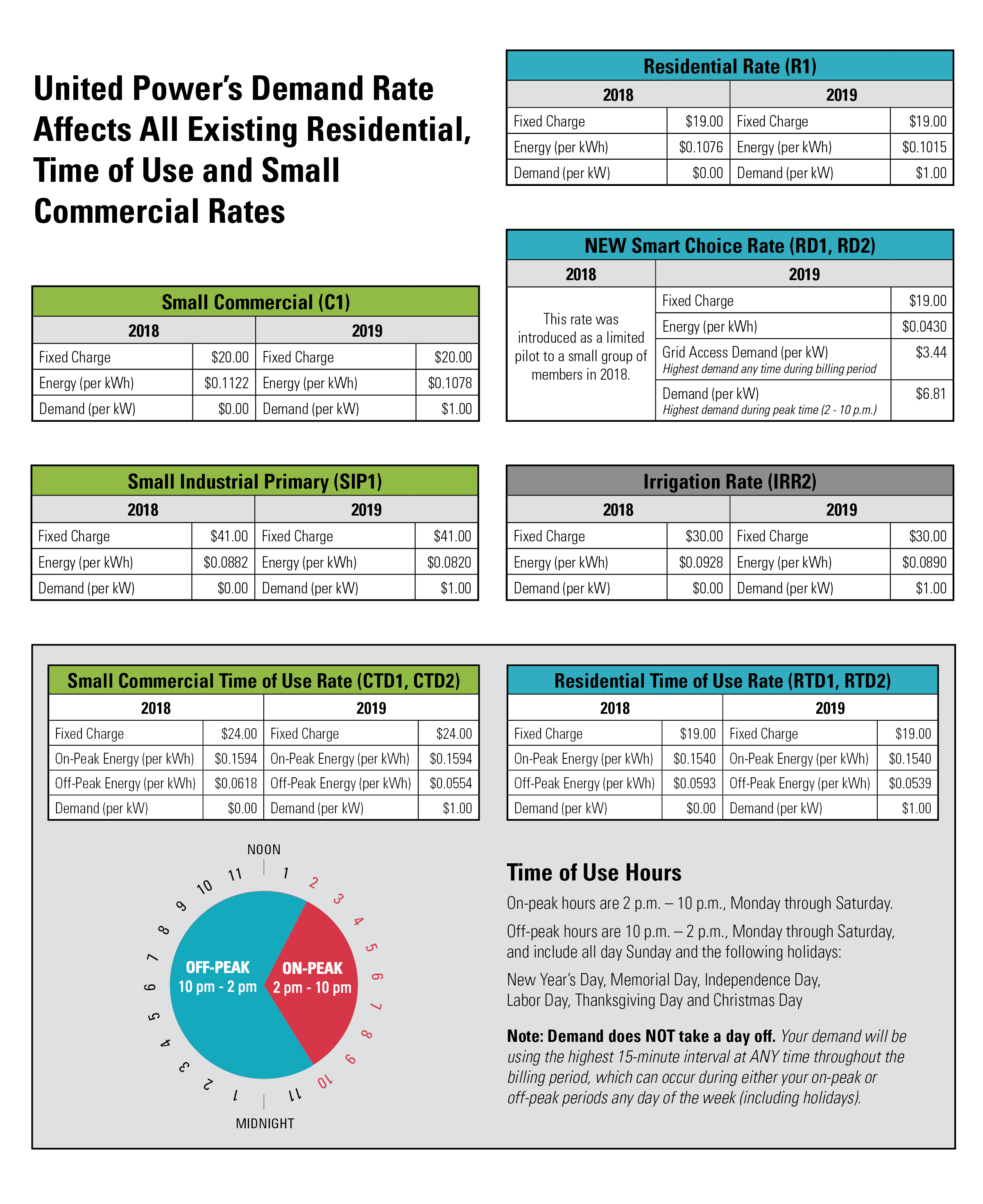
The Board will review proposed rate changes this fall, with the intention of introducing the rate slowly and incrementally over a four-year period. The process includes an extensive Cost of Service study, so rates are designed to reflect how the members affect our costs. Residential demand charges will be lower than commercial members. 

“Since we have detailed information about how members use power in their homes, the new demand rate will be a fairer way for us to bill members for their use,” stated Dean Hubbuck, Power Supply & Rates Director. “Residential users maximum impact on the system is lower than commercial customers, and their rates will reflect the difference. We believe a modest demand charge with a reasonable energy rate is the best way to recover our costs.”

Beginning in 2019, bills will show a charge for demand, accompanied by a corresponding reduction in the Energy Charge (kWh). The Demand Charge is figured by multiplying the highest demand interval (kW) by the per kW rate. Before final demand rates are approved, United Power is encouraging members to learn more about their personal electric usage and how they can make subtle changes to save even more.

You Have the Power

Curious to see when you used the most energy this past month? Was it the high temps or maybe your new hot tub using more energy than you expected? Use the Power Portal to pinpoint what’s driving your energy use. Access your complete energy consumption portfolio in 15-minute increments throughout the day to get a clear look at how you use energy. 

To use the Power Portal, login and click on My Consumption Data. Under the Usage Dashboard, select the Account to view, choose Current Month from the drop-down and select Billing Month. Under the blue bar chart, you may need to click the Demand option to turn on the orange Demand line in the graph. The orange diamond indicates the interval with the highest demand. Click the blue bar to display each 15-minute interval from that day. Hover over the graph for more detail. 

Learn more about the Power Portal and how to register at www.unitedpower.com/powerportal

PowerPortal_Monthly.png

The monthly view in the Power Portal presents your energy use for each day. Choose to view the month by calendar month to see the first through the last day of the month, or view by billing month to view from the first day through the last day of that billing cycle. Viewing your monthly usage helps highlight trends in when you use the most energy. 

PowerPortal_Daily.png

By clicking on any blue bar representing daily energy use, you can zoom in to see every hour of the day by 15-minute intervals. This view can help you pinpoint the interval driving your peak and help you recall activities in your home that contributed. 

Beat the Heat...and Your Energy Bill

Monday | September 3, 2018
If you’ve seen your electric usage trickle up over the past couple months, it might have something to do with Colorado’s hot summer weather.
Veteran United Power lineman Kelly Snow has been selected to join five other Colorado linemen and eight Oklahoma linemen to bring power to two remote jungle villages in Guatemala this September.

Title
Changes to How Electricity is Billed to be Phased-In Over Next Few Years
/sites/default/files/styles/news_card_553x430_/public/news/08_22_2018_DemandPhaseIn.png?itok=EWqGMaJe
Wednesday | August 22, 2018
Card Teaser
Following the results of a year-long trial of a pilot demand rate, the United Power Board of Directors agreed to a phase-in plan of a residential demand rate to replace the current rate structure.

Following the results of a year-long trial of a pilot demand rate, the United Power Board of Directors agreed to a phase-in plan of a residential demand rate to replace the current rate structure.

“Since we have detailed information about how members use power in their homes, the new demand rate will be a fairer way for us to bill members for their use,” stated Dean Hubbuck, Director of Power Supply and Rates. “The impact on the system from residential users is lower than commercial customers, and their rates will reflect the difference. We believe a modest demand charge with a reasonable energy rate is the best way to recover our costs.”

The dynamic pricing model will provide a more fair cost structure, and gives members an ability to control their costs by staggering the use of electric appliances.

Learning about how a demand rate works will take a lot of communication, so the five year period is being used to help our members and employees better understand the rate and how members can control their costs with some simple strategies.

All members will now be seeing a new line on their bill simply entitled “Demand Charge.” Initially, there will not be a dollar amount attached to this line item while we provide the information as education for members. By adding the new line it will allow members to see an actual number that corresponds to their use. In 2019 United Power will institute a demand charge and that will slowly increase, with a corresponding reduction in the energy charge.

United Power has been actively communicating how a demand charge works via the newsletter United Newsline and members can find more information about Residential Demand here on our website. This information is being presented ahead of the rate change so our members have the opportunity to gain an understanding of this new way of thinking about their electric consumption.

Many members will see very little change in their bills, but some members who use more energy all at once may be more heavily affected, and without the demand rate they have been driving up costs for other users. We will continue to communicate about these changes via the newsletter and our website.

Capital Credits: Your Piece of the Pie

Wednesday | August 1, 2018
This year, more than 80,000 checks will be issued to residential and business members. Anyone who had service in 2017 or earlier will be eligible for this year’s capital credit retirement.